

Study guide
Turn a chapter PDF into a study guide with key terms, a concept map and ten practice questions.
- Document
- Education
- By the Vife team
Example result
03 HIGH WATER AND LOW WATER
High water is the moment the sea reaches its highest level at a place; low water is its lowest. In between, the water ebbs (falls) or floods (rises). The difference in height between a high and the next low is the tidal range. The Moon returns overhead every 24 hours 50 minutes,…
04 SPRING TIDES AND NEAP TIDES
The words are not about the season — “spring” here means the water springs up, in any month of the year.
CONCEPT COMPARISON TABLE editable — rewrite any cell to match your own textbook or syllabus
Sample content for classroom practice — heights, times and examples are illustrative. Before any trip to the coast, check the local tide forecast and the safety notices for that beach or harbour.
Two observation exercises
Both use published tide predictions, so you can do them from a desk or a classroom — there is no need to stand near the water. Write in the spaces provided; the hints are below.
H ANSWER HINTS
▪ Timing. Successive high waters are about 12 hours 25 minutes apart, because the Moon returns overhead every 24 hours 50 minutes.
What you need
- Chapter PDFFile · Required
The prompt
Turn the attached chapter into a study guide for course or level: a one-page overview, key terms with plain definitions, the main ideas as short summaries with page references, a concept map, ten practice questions (mixed multiple choice and short answer) and an answer key on a separate page. Use only the chapter's content. Deliver a print-ready A4 PDF and an editable DOCX.
The outlined blanks are yours to fill in when you use the template.
Made with this template
Related templates
- docxHOLLOWAY | Community Repair Café Pilot Proposal
COMMUNITY OPERATIONS PROPOSAL · DRAFT 0.1
HOLLOWAYCommunity Repair Café Pilot Proposal
Prepared for: a public example · Status: concept draft for discussion · Pilot weekend: one Saturday + Sunday, date to be set · Concept example · Not a real project
About this document. This is a fictional concept proposal written as a public example of a warm, community-run repair pilot. It describes an intention to run one trial weekend, not a service that exists. Every figure in it is a simulated placeholder. Concept example · Not a real…
1. The core ideaThe Holloway Community Repair Café is a two-day pop-up where neighbours bring small broken household items and repair them alongside volunteer fixers. It is designed as a social room first and a service second: people wait, talk and learn at the same table where a lamp, a jacket…
This proposal asks for a single pilot weekend rather than an ongoing programme. Running once, in one venue, with a capped number of items, lets a small volunteer team test whether demand, capacity and the booking-to-feedback flow actually work before anyone commits to a recurrin…
What the pilot is designed to testDemand — that residents have a real backlog of small repairable items — and will bring them.
Capacity — that the room, tools and shift pattern can host roughly 24–32 items over two days.
Business plan
A 12-page business plan with a one-page summary and a projections workbook you can edit.
Document
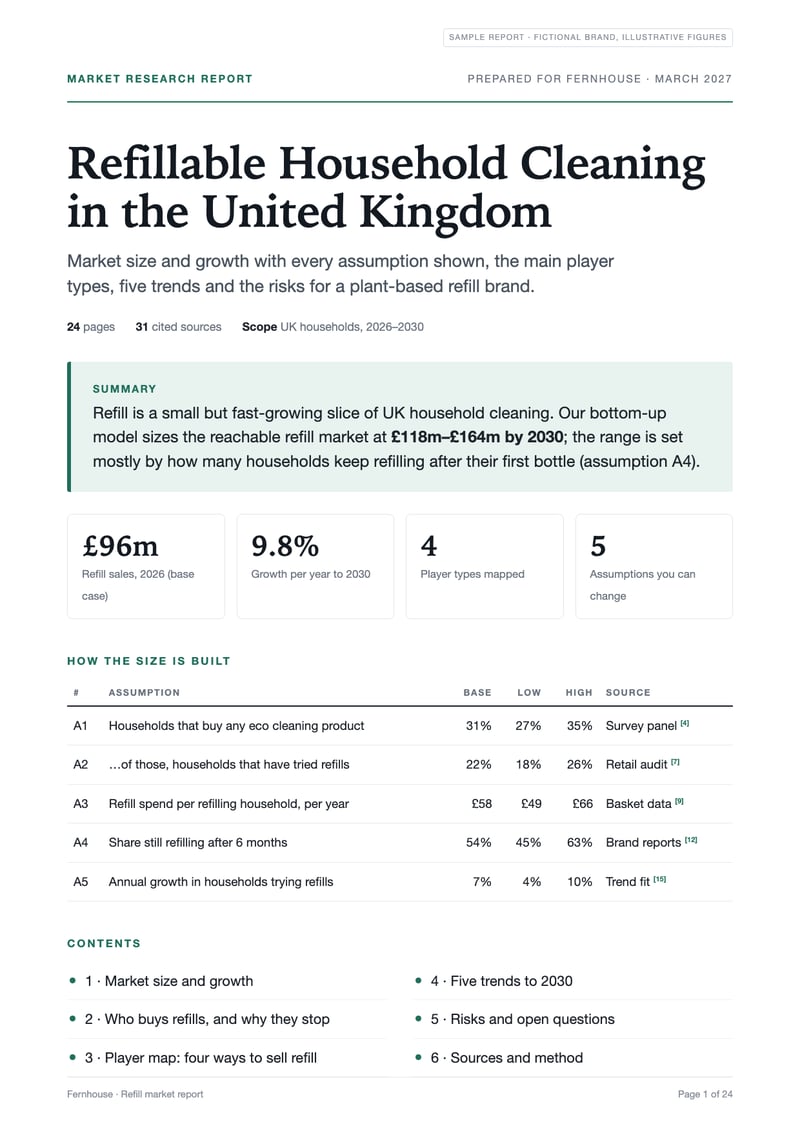
Market research report
A cited market report: size and growth with every assumption shown, players, trends and risks.
Document
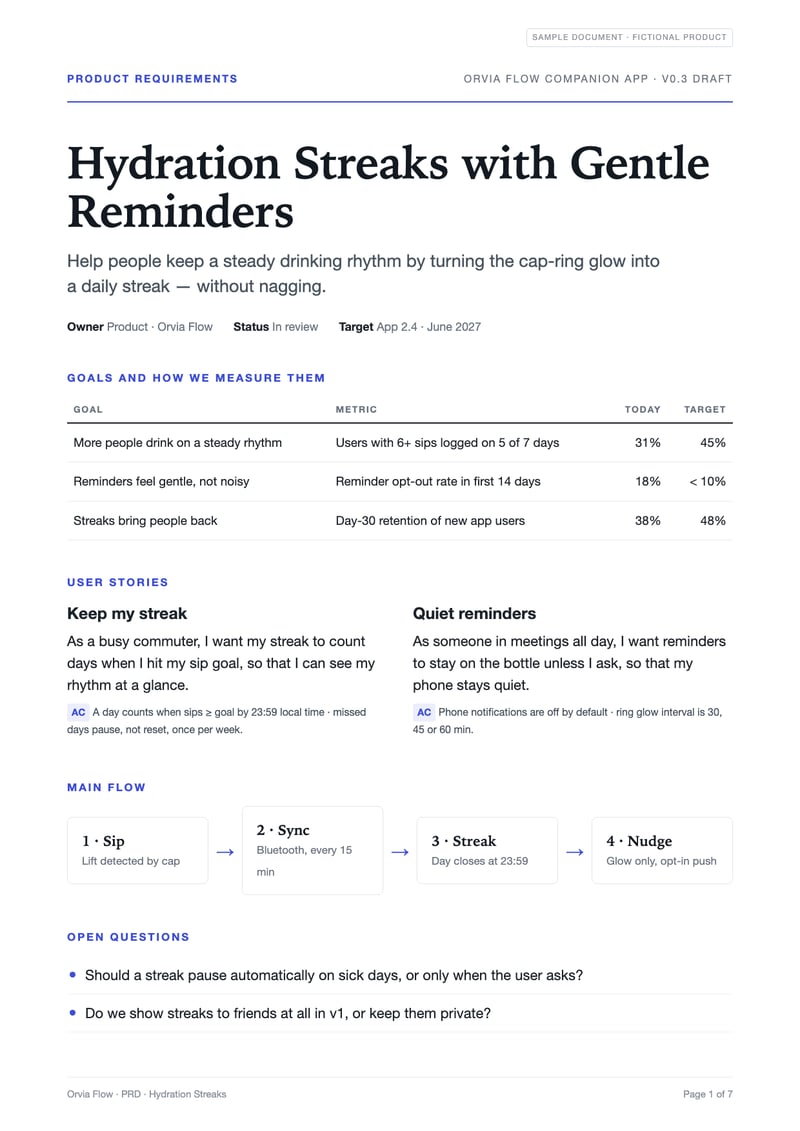
Product spec (PRD)
A PRD with measurable goals, user stories with acceptance criteria, the main flow and open questions.
Document
- docxResume and cover letter
JORDAN ELLIS [Sample content]
Store Operations Lead — now moving into User Research Operations
jordan.ellis@example.com · +1 555 0142 · Portland, OR [Sample content]
PROFILE
Store operations lead moving into user research operations. Six years [Sample content] in high-volume retail built the habits this role runs on: interviewing customers one to one, mapping the service process behind their complaints, and closing feedback loops with a decision rat…
TRANSFERABLE SKILLS
CORE SKILLS
EXPERIENCE
Store Operations Lead — Northline Home & Hardware [Sample content]
March 2022 – Present [Sample content] · Portland, OR [Sample content]
Resume and cover letter
Tailor your resume to a job post and get a matching cover letter, using only your real experience.
Document
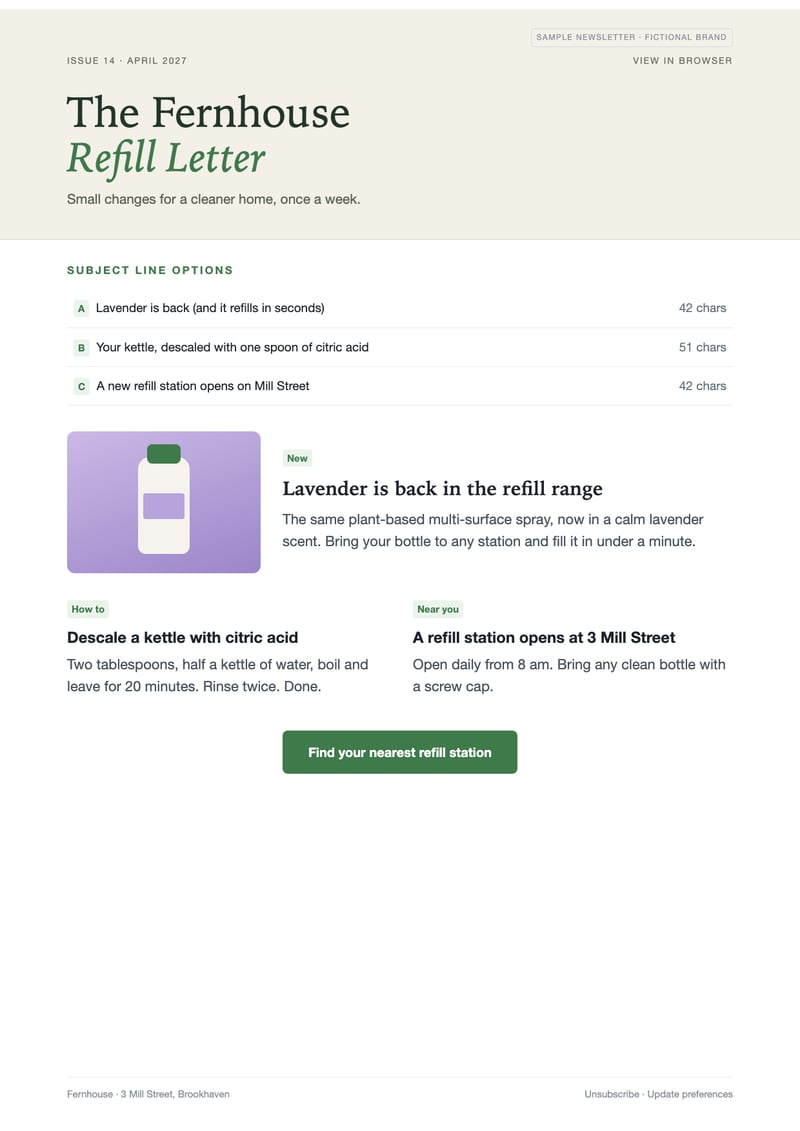
Newsletter issue
This week's newsletter from your topics or links: subject lines, three stories and email-ready HTML.
Document
- docxATLAS | One-Hour Museum Visit Guide
ATLAS | One-Hour Museum Visit Guide
One hour,four galleries.
A calm, self-guided route through a fictional city museum — with one highlight and one question waiting at every stop.
Welcome to ATLAS.
This is a short visit, not a survey. Follow one clear route from the entrance to the exit, stop at four galleries, and use a single question at each stop to keep the looking slow. The whole guide is editable: change the gallery names, times or prompts to suit your own venue.
Your route
One continuous, step-free route. About 12 minutes at a gentle pace without stops. The order is fixed; the time you spend is yours.
Choose your pace
FOUR STOPS · ONE HIGHLIGHT EACH
Look closer, stay longer.
Trip handbook
A printable day-by-day travel handbook with maps, checked opening hours and a packing list.
Document
- docxPolicy draft
Version 1.0 · Last updated: [insert date] · Next review: [insert date]
1. About this guideNorthline Collective is a fictional, remote-first product team. This guide is the single starting point for a new joiner's first 30 days: the onboarding timeline, how we work asynchronously, how account access is requested, the first-week tasks and the 30-day review.
How to use this guide
Managers: copy this document, replace every [bracketed] field with real names, dates and tool links, and share it with the joiner at least three business days before Day 1.
New joiners: work through Section 5 in week 1 and bring the Section 6 self-assessment to the 30-day review.
People Ops: keep Sections 2 and 4 aligned with the current handbook, systems list and legal requirements.
Who's who during onboarding
2. Onboarding timelineThe timeline runs from five business days before Day 1 to the Day 90 check-in. Each phase ends with a milestone that must be met before the next phase starts; if it is not met, the manager and joiner agree a revised date in the tracker.
Policy draft
A plain-language company policy draft with legal review points flagged (not legal advice).
Document
- Audio
Podcast from an article
Podcast from an article
Turn an article or PDF into a 5-minute two-host episode with music, chapters and show notes.
Audio